Potential Is Not a Promise
This is a fictional version of a story. It holds real emotional patterns, but it is not medical, legal or psychotherapeutic advice. ADHD here is not an 'enemy' or a label. The enemy is the avoidance of responsibility, alcoholic chaos, and the habit of treating someone else's pain as background.
- The secret: the dream of the captain is not decoration — it's the hook that keeps Tonya where ordinary logic would have walked her out long ago.
- The question: is this fate, or a coincidence a woman hung too much hope on?
- The pain: she was in contact, but felt alone. He was warm, but not reliable.
- The use: it shows not 'how to fix a man,' but how to tell love from rescuing, chemistry from safety, a diagnosis from an excuse.
The Characters
She wants love, closeness, safety, depth, passion and real actions. After a toxic marriage and an escape to Prague she lives carefully: two teenagers, a deaf white cat, an old rescue dog, total isolation as a form of self-defence. Her contradiction: she's afraid of becoming again the woman who waits, excuses and rescues — who has to be the adult for two.
Social, funny, alive, capable of being kind and very warm. Inside — lonely, poor at holding closeness, hiding in stimulation, travel, alcohol and jokes. His contradiction: ADHD-traits and a drinking problem. He can feel more than he shows, but keeps failing the actions that would have made love safe.
- The dream — a beautiful trap: it makes Josh significant before he's had time to become reliable.
- Alcohol — not 'Irish colour' but a mechanism of damage: first funny, then humiliating, then dangerous.
- ADHD — not a verdict and not a permission to wound.
- Prague — not a postcard but a city-threshold, always asking the heroes to cross or to stop.
Reality Rules for the Story
We don't write 'he's like this because he's Irish' — that would be flat and unfair. We write: he lives in a culture where the pub is a familiar social language, but personal responsibility begins where a habit starts to destroy a person and the people around him.
- Pub culture can be social and warm, but regular heavy drinking is not 'character.' Josh uses the pub both as a place of contact and a place of escape.
- Adult ADHD shows up as distraction, forgetfulness, trouble organising time, impulsive decisions and difficulty finishing things — useful for Josh's fictional logic, but the book diagnoses no one.
- Alcohol can wreck sleep — sedation first, then lighter, less restorative rest. So Josh's nightmares and his crashes after drinking are logically linked.
Contents
The Dream That Wouldn't Let Her Go
Tonya didn't fall in love only with Josh — but with the man he could have become. Potential can be beautiful. But you can only live beside actions.
The silence in her flat was not an empty one. It lived there alongside girls' hair ties, an old dog who snored as if he were guarding the whole district, a white deaf cat with eyes the colour of cold glass, and two daughters who already knew how to slam doors with full teenage philosophy: loudly, briefly, and without explanation. Prague outside the window didn't comfort her; it simply glowed with its old yellow light, like a city that has watched other people's marriages, wars and emigrations — and still sells everyone coffee every morning.
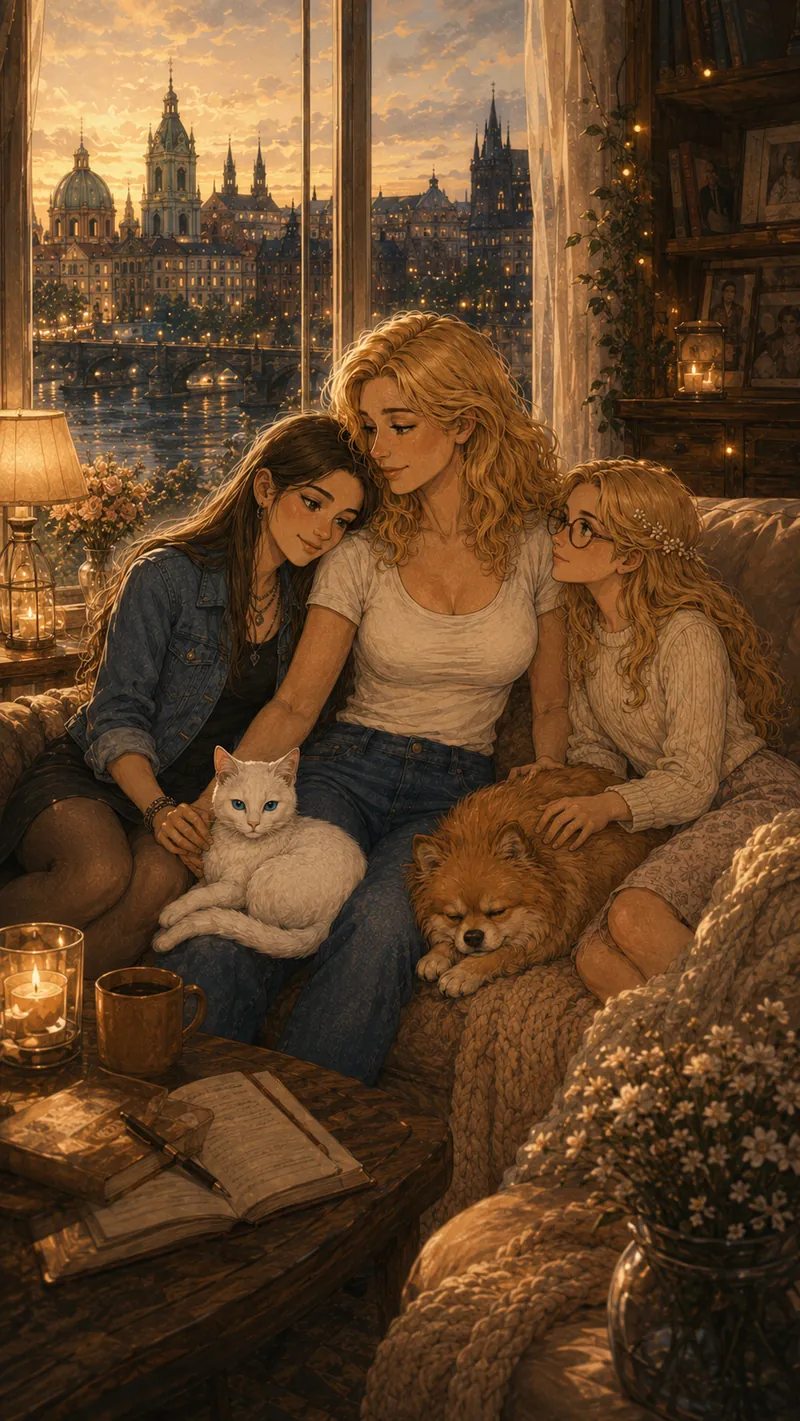
Tonya didn't call it loneliness. Loneliness sounded pitiful, as if someone hadn't shown up to a party. Her state was more precise: chosen isolation. After a man who called control 'care' and humiliation 'character,' she had learned not to open the door even when there might be flowers on the other side. Especially then.
She had a list. Not the silly 'prince on a white horse' list, not a girlish fantasy about broad shoulders — though no one had cancelled shoulders, of course; she was alive, not a saint from an advertising brochure. On her list there was: stability, respect, sobriety, depth, passion, action, safety. A man had to come on his own, but not barge in. To notice her, but not drag her into his chaos. To want her, but not turn her into a function.
And it was on exactly the night she decided she wasn't looking for anyone anymore that a dream opened the door without knocking.
Before the man, there was the sea. Some women are warned in their sleep — long before they are tested awake.
First there was a ship. Not a modern one, not a tourist one, not the kind where people in shorts photograph the sunset and pretend they've found the meaning of life for the price of a cocktail. It was a heavy, dark ship with wet ropes, brass lanterns, a staircase rising upward, and the kind of wind that doesn't ask whether you're ready for change. On the upper deck stood a man in a captain's uniform. She couldn't see his face fully — only the line of a shoulder, the darkness of his hair, the calm of a figure that seemed to know where the storm was leading.
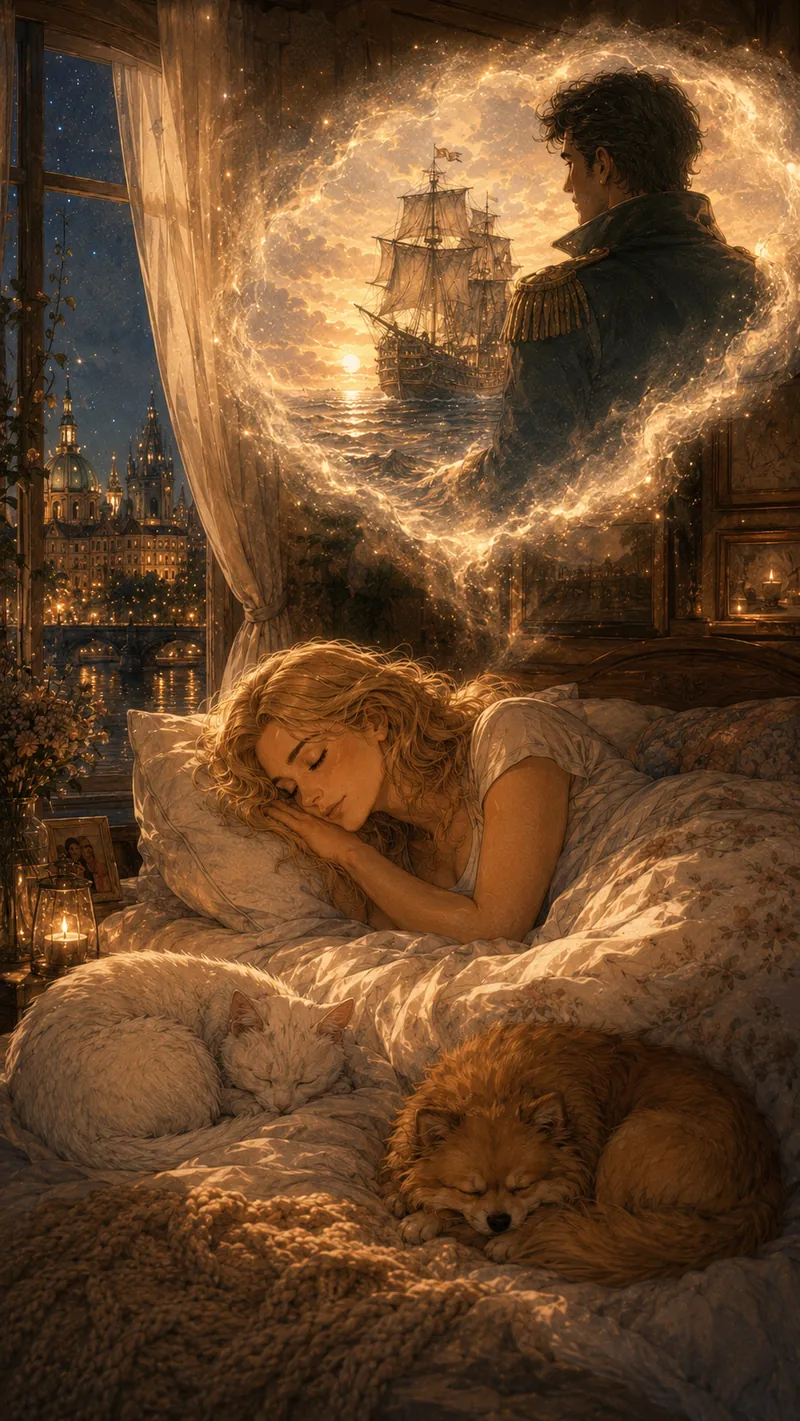
In the dream she understood: it's him. The very man from the list, but without the list. Not because he matched its points, but because beside him her body stopped holding its defence.
Then the dream broke. The staircase became a palace one, like in the old Anastasia cartoon, where a ball turns into an escape, the music into a warning, and the past suddenly turns out not to be dead, just well-dressed. Below, people were noisy — someone ran, someone shouted, someone held a door as if a whole life depended on it. The captain vanished for a moment, and in his place stood another man. Not entirely a stranger. Too similar to wave away, and too different to believe.
In the dream Tonya tried to protest, but no voice came out. She only watched as 'her' man seemed to hide inside the other one: behind a smile, behind chaos, behind a kind of boyish carelessness, behind a light that kept appearing and going out. And in the dream she sang him something about a wind of change — not literally the cartoon song, but that strange inner request a woman sometimes sends a man without words: please, become yourself, while I'm still here.
In the morning she woke not abruptly, but as if someone had carefully lifted her out of water. The cat slept at her feet, the dog lay beside her in a heavy warm lump, and outside the window Prague pretended nothing mystical had happened. The kettle clicked, one of the children dropped a spoon in the kitchen, life returned to a schedule with no room for captains and palace coups.
But the dream didn't disappear. It stayed in her body, like the smell of the sea on clothes you have never worn. And that was more dangerous than any message from a stranger — because a message can be deleted. A dream cannot.
The dream becomes the main psychological hook: it inflates the meaning of coincidences and stops Tonya from judging Josh's actions soberly.
A strong symbol must not cancel a reality check. Any 'sign' is obliged to be confirmed by actions.
Is this fate — or a coincidence a woman has hung too much hope on?
He Came Up From Behind
A coincidence that looks too precise to be just a coincidence.
On the evening of the third of April, Prague smelled of wet stone, coffee, and tourists who hadn't yet understood that comfortable shoes in the Old Town aren't advice but a matter of survival. Tonya walked with a single wireless earbud, because with the other ear she was still listening to the world — not out of interest, but out of the habit of a woman who once noticed danger too late.
She wasn't looking for encounters. In that period she treated people roughly the way you treat pop-up ads: you can look, but it's better to close them before anything starts.
In the café she chose a seat by the window, because by the window you can be among people without being with them. The latte was hot, a little sweet, almost childish. Nothing important was happening on her phone, which was a luxury in itself: no one was demanding, accusing, checking, or trying to enter her life under the guise of care.
“Hey, sorry… do you speak English?” The voice came from behind, too alive for a man simply asking for directions. Tonya didn't realise at once that it was aimed at her. In her world, unfamiliar men usually existed as background — and if they tried to become an event, she politely turned them into a connection error.
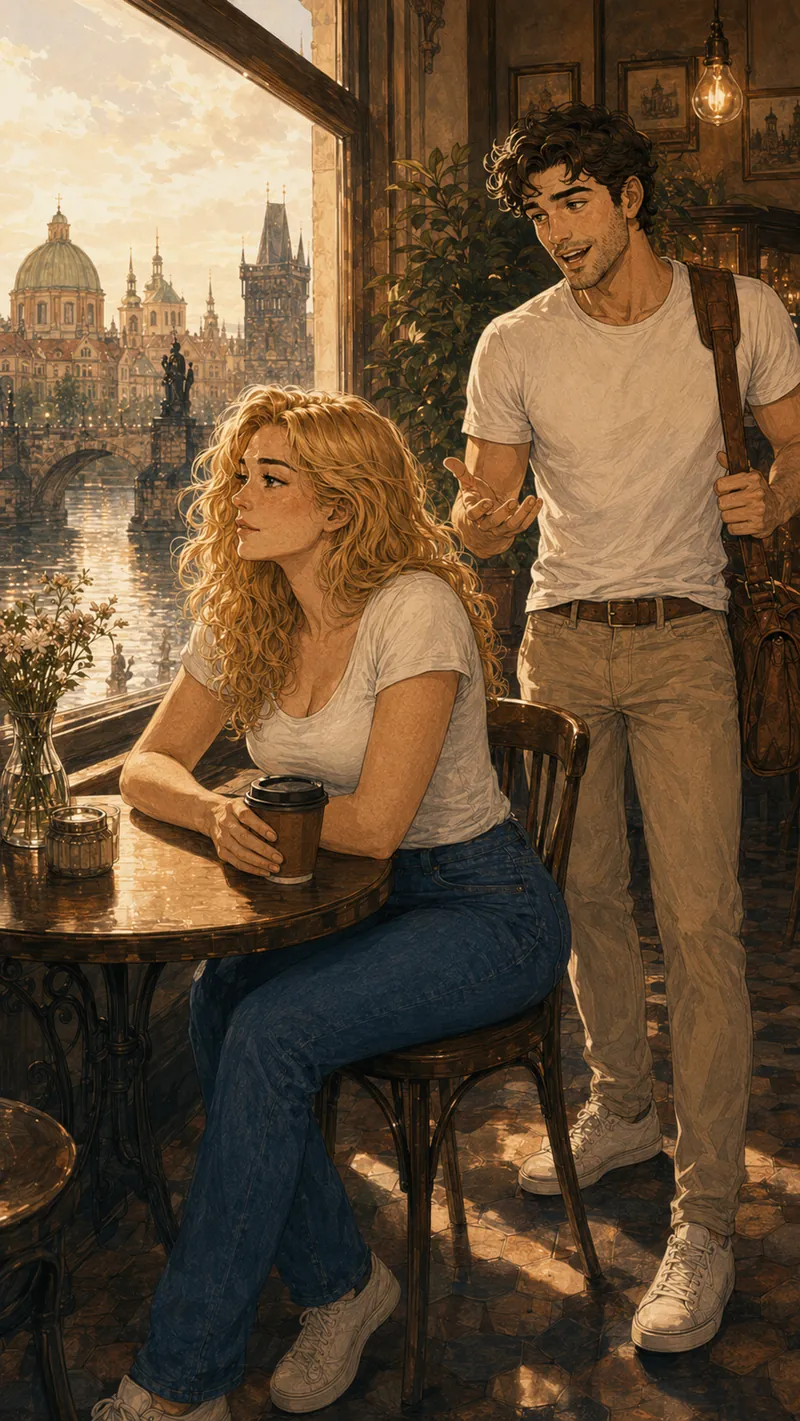
“A little,” she said, and immediately regretted it, because “a little” in her case meant: I can order coffee, say I have children, and at worst disappear gracefully. “I'm Josh. From Ireland. I travel a lot. Prague is… wow. You live here?” She smiled the smile women use instead of a translator: softly, promising nothing.
He talked fast, jumping from Prague to football, from football to Ireland, from Ireland to travelling, from travelling to some pub where, in his opinion, they served the best Guinness outside Dublin. He'd already been drinking. Not frighteningly drunk, not aggressive — more loud and warm, like a man who can make a whole room his acquaintance. Tonya couldn't stand drunk men. After her past, alcohol on a man's breath was not a smell but a siren. But for some reason the siren didn't go off as loudly as it should have.
When he asked for her socials, she almost laughed. His profile had too many people, too many photos, too many open doors. She had a few friends and an instinct to hide. The paradox was almost comic: a one-man band asking for the contact of a woman who dreamed of being invisible.
She gave him the contact because she decided: I'll delete it. A very grown-up, rational, magnificently pointless thought of a woman already taking the first step toward her own future insomnia — and still proud of being in control of the situation.
'I'll delete it' is the most reliable sign a woman has already decided not to.
On the way out he suddenly asked: “Have you seen Anastasia?” — “What?” — “The cartoon. Anastasia. You know? The song, the palace, all that dramatic Russian princess stuff.” She looked at him as if he had just pulled a wet rope out of her dream and laid it on the table between her paper latte cup and her caution.
The odds that the night before she would dream of a palace coup, a replaced man and an echo of 'Anastasia,' and the very next evening a drunk Irishman in a Prague café would ask exactly this question — that wasn't mathematics. It was mockery.
They were so different that any sensible woman would have closed this tab at once: she — silence, children, a translator app, a list of requirements for a man, a carefully stitched-up heart; he — football, pubs, trips, people, laughter, impulse, the Irish 'it's grand' behind which sometimes hides anything but grand.
When she stepped outside, the city was noisy as usual. A tram clanged, tourists laughed, a shop window gave her back the reflection of a woman who looked calm. But inside, under her ribs, the dream and reality had already begun to argue.
She told herself it meant nothing. Just a conversation. Just a coincidence. Just an Irishman who talks to everyone because, apparently, his boundaries are set somewhere in a different time zone. And then the phone in her hand grew heavier than a phone with one new contact should be.
The dream + 'Anastasia' + a chance meeting create a sense of the mystical — and that is exactly what stops her from judging soberly.
A first coincidence does not equal compatibility. It matters to look not only at the magic, but at the behaviour.
If a person arrives too 'meaningfully' — is he obliged to be the right one?
He Didn't Notice Her
A strange man who somehow wouldn't leave her head. A profile like a Friday-night station. A wave at four in the morning. And one cruel coincidence in a beautiful garden, where fate stood three steps away — and looked the other way.
That evening Tonya told her mother about him the way women talk about strange men who, for some reason, won't leave their heads: with a smirk, with corrections, with the obligatory attempt to prove it doesn't matter at all.
— Imagine, an Irishman came up to me. Cheerful type. Drunk, of course.
— But you can't stand men like that.
— Exactly. So it's fine. I'll delete him.
Her mother stayed silent just long enough for the sentence to become funny.
Before sleep, Tonya opened his profile after all. It was called 'checking what kind of person he is.' Translated from female into honest: 'scrolling deep enough to later pretend you were looking for nothing.' Football. Manchester United. Bars. Friends. Trips. A smile in every city, like a boarding pass. He was a man who entered other people's frames easily, and that was both irritating and magnetic.
A friend would have said it was obvious: a man like that meets everyone, adds everyone, collects attention, lives on reactions. Tonya almost agreed. Her own page was like a small, closed room. His — like a station on a Friday night.
On the morning of April 4th she saw his story: a bar, a screen showing football, and next to Josh a girl — young, beautiful, light, the kind who looks as if she doesn't know the words 'child support', 'trauma', or 'please don't touch my soul with dirty hands.' They were laughing. He was in his element.
What Tonya felt wasn't even jealousy. Jealousy requires status. And she had no status. She had only a dream, a contact, and a humiliatingly alive interest.
Then she saw the message. On Facebook, at four in the morning: a waving emoji. The cheapest gesture in the history of human hope.
She immediately built a version: it didn't work out with the girl, so he remembered the backup option. The version was cruel, but convenient. Convenient versions often feel true only because they protect your pride.
She didn't reply. Her finger hovered over delete, but didn't press. A grown woman can survive a divorce, a move, teenagers, utility bills, and a deaf cat who yowls at three in the morning because she can't hear herself. But deleting a man who asked about 'Anastasia' after her dream — now that is a complicated administrative procedure.
In the daytime she went for a walk. The Wallenstein Gardens were beautiful to the point of indecency: greenery, peacocks, stone walls, an old order that pretends human life can be symmetrical too. She talked to her mother on the phone and walked fast, because if you walk slowly, your thoughts catch up.
And suddenly she saw him. Josh was right there, in that impossible closeness where a city of millions of footsteps shrinks to a few metres. He stood a little to the side, with his phone, with the face of a man who was already inside another noise. Drunk. Not wrecked, but tipsy enough for the world around him to lose its focus.
He didn't notice her.
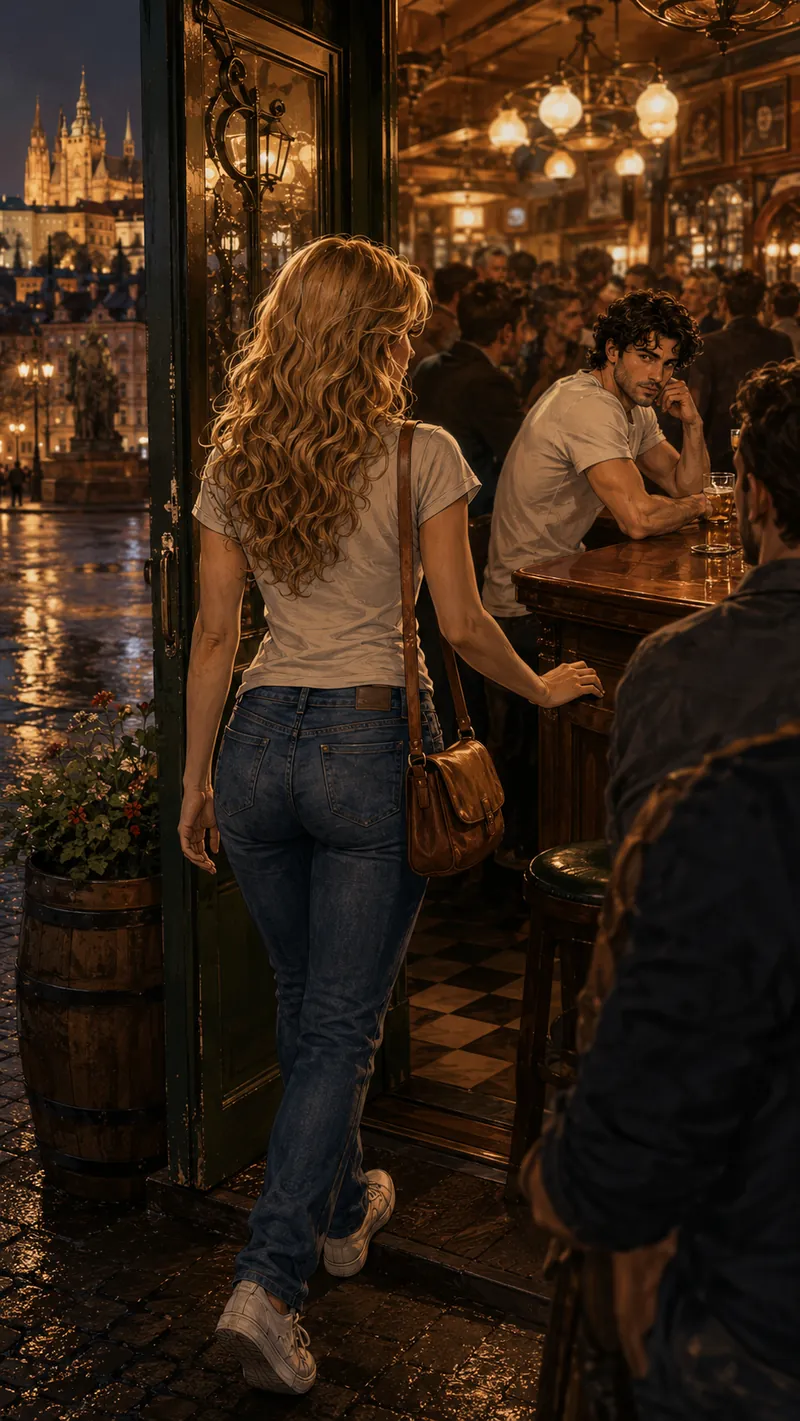
Later she would return to this moment like a frame with the wrong exposure: here he is, here she is, here is the chance, here are his eyes looking the wrong way. From his side it might not have been indifference. ADHD can make the world too loud: streetlights, people, the phone, a thought, a notification, the smell of food, a scrap of conversation. And alcohol adds to that the dull certainty that you're in control of everything.
But pain doesn't have to become smaller just because it has an explanation.
Tonya walked past and didn't call out to him. Pride held her shoulders tighter than any man. 'My man will always find me,' she thought, and the thought sounded beautiful, almost like a quote. Only that day her man was standing a few steps away and couldn't even find her face.
The city became big again. And the coincidence — even crueller.
A wave at 4 a.m. is not the same as being chosen. Sometimes the most romantic line a woman tells herself — 'my man will always find me' — is exactly the line that keeps her standing still while life walks past.
Not answering a 4 a.m. wave isn't pride — it's self-respect, when a person hasn't given you any clarity.
ADHD can explain distraction — but it doesn't cancel the fact that the other person is in pain. An explanation is not the same as a repair.
- He reached out at a normal hour, not only when he was bored or drunk.
- There was a real sentence — not just an emoji.
- I'm answering because I want to — not to keep my hope alive.
Where does 'he's just like that' end — and 'I'm making excuses for him again' begin?
He Disappeared. Then Invited Her to Dublin
This is the chapter that separates an impulse from an act. He writes; that is not the same as choosing. And a woman learns the difference the hard way: by almost buying a ticket to a city that was never really offered to her.
By the eighth of April, Tonya was almost proud of herself. 'Almost' is when a woman still checks whether a man is online — but does it with the face of someone 'just looking at the weather.' She decided to delete him that evening. Not dramatically, no internal orchestra, no farewell speech into an empty chat. Just delete him and get her brain back.

Her phone buzzed first. 'I'm flying home.' She looked at those three words as if they were a ticket — but with no destination city.
Josh was flying home, to Ireland. To Dublin. To his world of football, pubs, people, noise — and that lightness which, from the outside, looks like freedom, until you notice the man simply doesn't know how to fully come back anywhere.
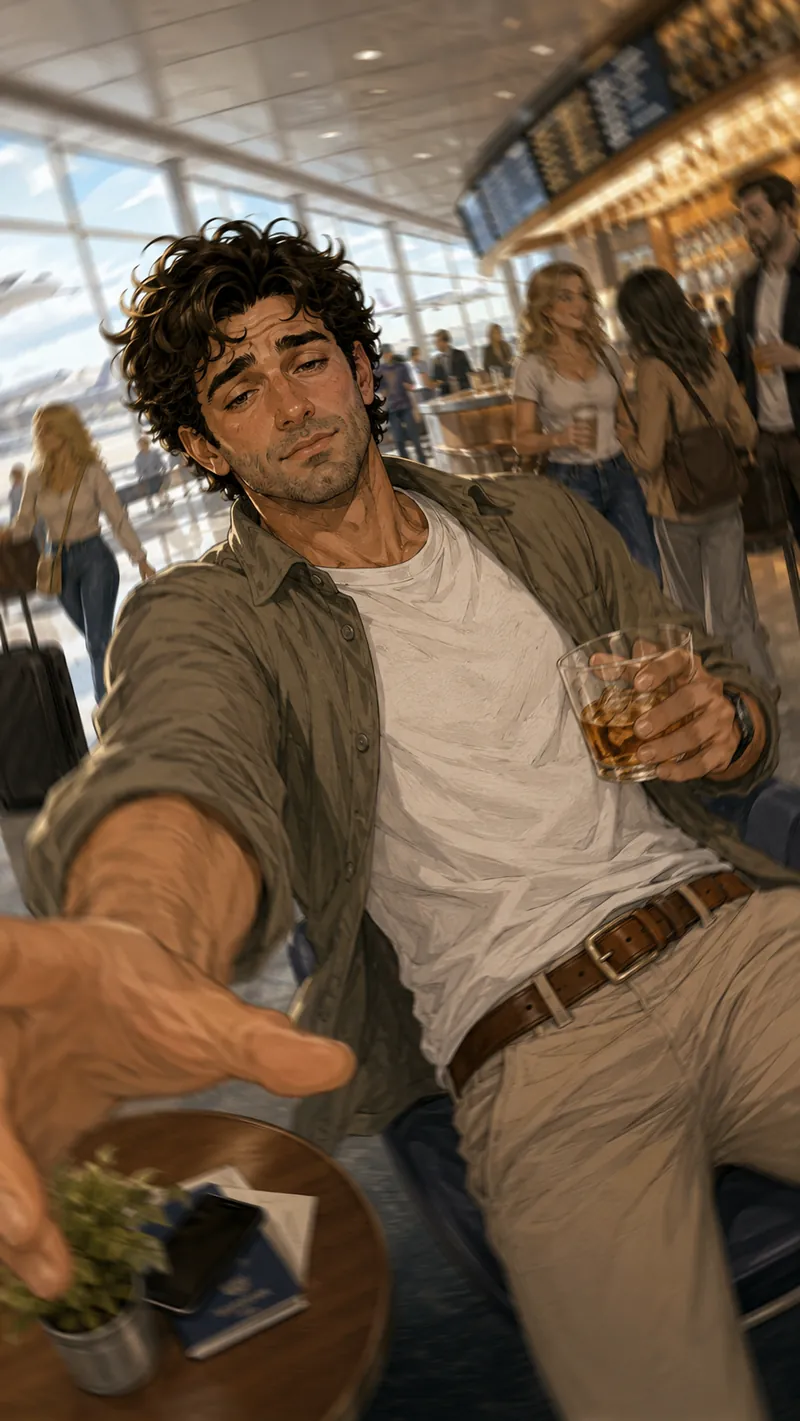
Then he wrote about coffee. Someday. In Dublin. For a second Tonya pictured a rainy street, green signs, his laugh, a cup in her hands, herself in a foreign city where she understands English even worse than in Prague — and a man who maybe doesn't even realise he's just launched, inside her head, an architectural competition for a bridge between two countries.
She would not fly. The decision wasn't cold. It was adult — and adult decisions are often unpleasant precisely because, inside, you still want the romantic foolishness.
His world swallowed him back: a loud, friendly, moving place where there is always one more pint, one more match, one more reason not to be still. From the outside it looks like a man who loves the world. From the inside it is a man who has nowhere he fully returns to.
She wrote back calmly. No resentment. No 'what did you mean.' No 'I want that too.' Because an invitation without a date, effort or clarity is not an act. It's a balloon — beautiful, until you try to lean on it.
Josh sent an emoji, then something else light. And vanished into the place he found most familiar: motion.
Tonya left the phone on the table and, for the first time, put into words a sentence that would later become one of the most important in this book. The latte went cold while she sat with it — the way coffee does when a woman is busy understanding something instead of drinking.
A text is not the same as being chosen.
Prague burned with evening light beyond the window. The chat was silent. And the question stayed in the room with her like a quiet guest: was that a chance — or just noise?
An invitation without a date, effort or clarity is not an act — it's a balloon. She doesn't fly to him not because she doesn't want to, but because he hasn't taken a single adult step.
A text is not a choice. An invitation with no date, no effort and no clarity is a feeling he had — not a plan he made. You're allowed to wait for the plan.
- There's a concrete date — not 'someday'.
- There's effort from his side, not just an idea.
- I'm travelling toward an act — not toward a fantasy.
If your head is already building a bridge to another country off one light message — pause. Notice the difference between what you're imagining and what was actually offered. Dignity is not coldness; it's refusing to lean on a balloon.
Is this invitation a bridge I can stand on — or a pretty balloon that pops the moment I put weight on it?
Poland, Croatia, and the Word 'Children'
A habit nobody agreed to. A drunk promise about children at the wrong hour. And a woman watching her own list of requirements slide quietly onto the floor — while she stands over it pretending it's part of the décor.
Their texting didn't begin like a relationship. More like a strange habit nobody had agreed to, yet both of them somehow opened their phones more often than they'd care to admit. Prague on one side, the road on the other.
Josh was in Poland, then already in Croatia, then at an airport, then on a street, then in a bar, then by the sea, then among people Tonya didn't know and already slightly disliked, simply for being near him when she wasn't. He wrote fast, funny, sometimes tender, sometimes so incoherently that the translator produced phrases like the poetry of a drunk refrigerator.
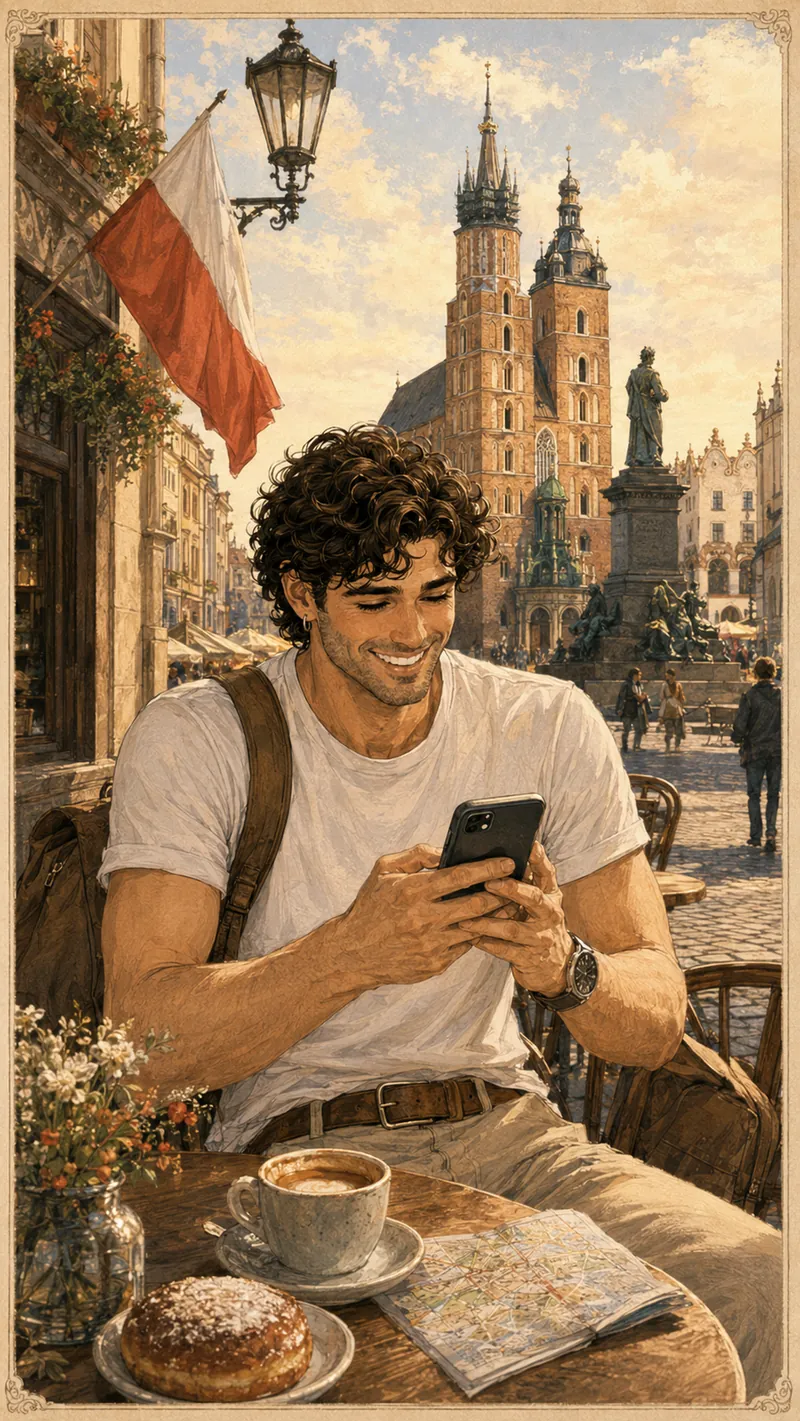
Tonya was annoyed at first, then laughed, then caught herself waiting for the next absurdity. That's how attention turns into a habit before you've had time to ask whether the source is reliable.
One night he was clearly drunk. Not 'a little relaxed', not 'Irish culture, everyone's smiling', but in that state where the words run ahead of the man while the meaning tries to catch up in its slippers.
In the dark the phone glowed between them like a small campfire for two, lit in different countries. And it's on nights like these that anxiety walks into a conversation before manners do.
'You can't live like this,' she said into the phone, and the translator dutifully turned her worry into a dry English sentence. 'At least think about future children.'
She surprised herself by saying it. She already had children. She hadn't planned to discuss reproductive strategy, heredity, alcohol and the fate of a future generation with a man she'd met once. But that's how anxiety works: sometimes it arrives in a conversation before propriety does.
Josh answered almost at once. He wanted children with her. Tonya reread the translation twice. Then a third time — because hope always asks for a technical recheck.
'I already have children,' she wrote. 'You understand that, I hope.'
'One more. With you. And if not with you — then with no one.'
It was insane. It was wrong. It was too early, too drunk, too beautiful and too dangerous — and, of course, that's exactly why it landed where it shouldn't have.
Tonya looked at his old photos. He was younger, leaner, even more handsome, with eyes that seemed to promise depth — even if their owner was, at that moment, choosing the bar over sleep. She was angry at herself for loving those eyes. For wanting to believe in the man inside the chaos. For the fact that her list of requirements was already lying somewhere on the floor, while she stood over it pretending it was part of the décor.
Josh later admitted he hadn't written sooner because he was afraid she was in a relationship. It sounded almost touching — if you didn't remember how many times he'd chosen noise before choosing clarity.
At the end of the conversation he said he wanted to come to Prague. Tonya looked at the screen and didn't know what she'd just heard: a man's decision — or the drunk version of a future that wouldn't remember, by morning, what it had promised.
Drunk tenderness can sound like destiny. But a promise made by alcohol is often an orphan by morning — no one comes to collect it. A future is built by a sober voice, not a midnight one.
'I want children with you', said by a drunk man you've met once, is not a plan for the future — it's chemistry in the moment. It hooks hard. But an adult future is built by a sober voice, not a night-time one.
- It was said sober — not at night under alcohol.
- Actions follow the words — not another disappearance.
- He sees my children as part of my life — not a line to scroll past.
If you catch your list of requirements lying on the floor and you're calling it 'the décor' — pick it up. That list wasn't written by bitterness. It was written by the woman who already knows the price of chaos.
Am I falling for his eyes — or for the man who looks at me with them and then chooses the bar again?
Prayer, Demons, and Croatia
A dream of an old church. A man on his knees, asking to be changed. And the demons that come when the asking is real: alcohol, fear, avoidance, noise. The light offers him a chance at responsibility. He reaches for it — and loses it again, this time in Croatia.
Josh dreamed of a church. Old, stone, Catholic, with cold pews and the kind of light that doesn't comfort you — it sees you. He was on his knees, not because he was holy, but because he was tired of himself.

The stained glass trembled, the candles smoked, and somewhere deep an organ held one low note, as if God too didn't quite know what to do with him but was tired of waiting for him to stop joking. 'Help me,' Josh said in the dream. It didn't sound beautiful. More awkward — like every honest plea from people used to turning their pain into a punchline.
The shadows in the corners began to move. First came alcohol — not as a bottle, but as a cheerful friend who slaps your shoulder and says 'one more, you'll be fine.' Then fear: grey, stooped, with the face of a man certain that if he's seen as he really is, everyone leaves. Then avoidance — a quick, nimble demon with a phone in its hand, always knowing where to tap so it never has to answer what matters. Then boredom, shame, impulse, the crowd, the noise, someone else's laughter.
They pulled him in different directions. And far off, a light appeared. Not a woman as a reward. Not Tonya as a cure. The light was a possibility: to gather himself, to admit, to choose, to endure the silence, to become a man — not because someone was waiting, but because otherwise he would lose himself. Something inside Josh reached toward that light.
Then one of the demons laughed in his own voice, and Josh gave up.
He woke up not in a church. A white ceiling. A stranger's room. A dry throat, a heavy head, the mark of a wristband on his arm, the smell of a bar on his clothes, and on his tongue the taste of a shame no mint gum or joke could cover. Croatia. The police. A bar too loud. Almost a fight. Strangers who hadn't found his fun charming.
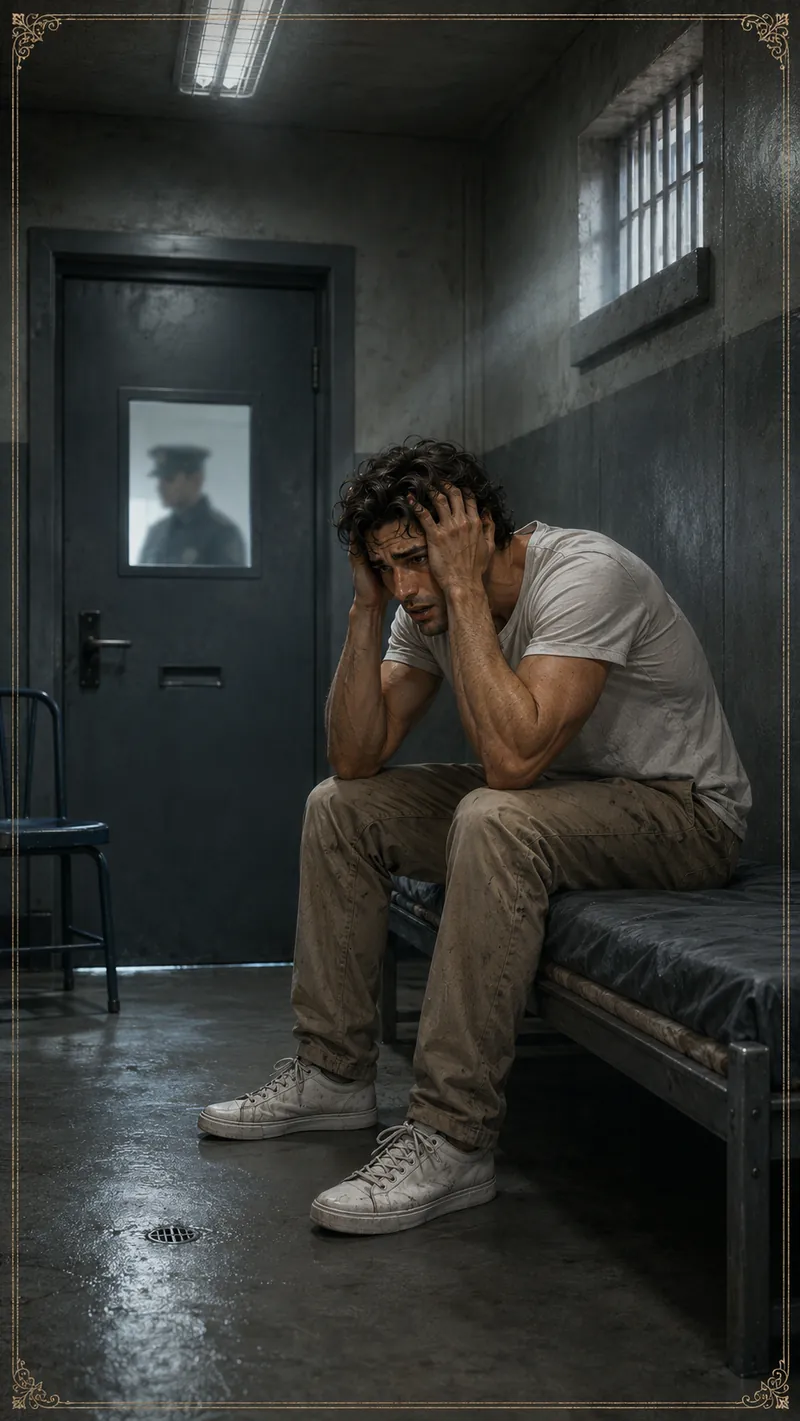
Tonya didn't know the details. She just saw the silence. She worried so much that she was angry at herself for it.
She wanted to write 'I told you so', and didn't. She wanted to finish him off with logic, and held back. Because sometimes a woman makes a titanic effort not to destroy a person at the very moment he's already lying face-down in the consequences.
He said he'd come earlier. Via Vienna. He sent a video from the airport. Tonya looked at him on the screen — alive, handsome, a little guilty, still not put-together — and once again let hope raise its head.
A few hours later, he vanished.
The light in this dream is not 'God sent him a woman.' The light is a chance at responsibility — to gather himself, to choose the harder, quieter thing. He reaches for it. And then he loses it again. Love cannot save a man who won't choose to save himself.
The light in his dream is not Tonya, and not love as a prize. The light is the chance to become responsible. You cannot be someone's rescue. He has to walk toward his own.
Sometimes the most mature thing is to swallow 'I told you so' while someone is face-down in consequences. That isn't weakness — it's mercy. But mercy toward another does not have to cancel care for yourself.
- I can tell 'he wants to change' from 'he is changing his actions'.
- Alcohol that breaks plans, safety and boundaries is a risk — not cute chaos.
- I let hope rise, but I don't let it make decisions for me.
Am I waiting for him to save himself — or am I about to do it for him again?
He Promised to Come. And Vanished.
Two days without sleep. Tabs of tickets to Vienna, opened and closed. And then a man, alive and strange in his stories, blaming the airport, the rules, the weather — anything but his own choice. This is the chapter where she's already ready to rescue, even though she doesn't want to.
Tonya hadn't slept for almost two days. That's not a pretty phrase. It's when the tea goes sour, your eyes sting from the phone, and routes start forming in your head: Prague–Vienna, Vienna–airport, airport–police, hospital, an unknown terminal, a foreign country, a foreign man who isn't really yours — but your heart is already behaving as if you share a mortgage, a dog and twenty years of marriage.
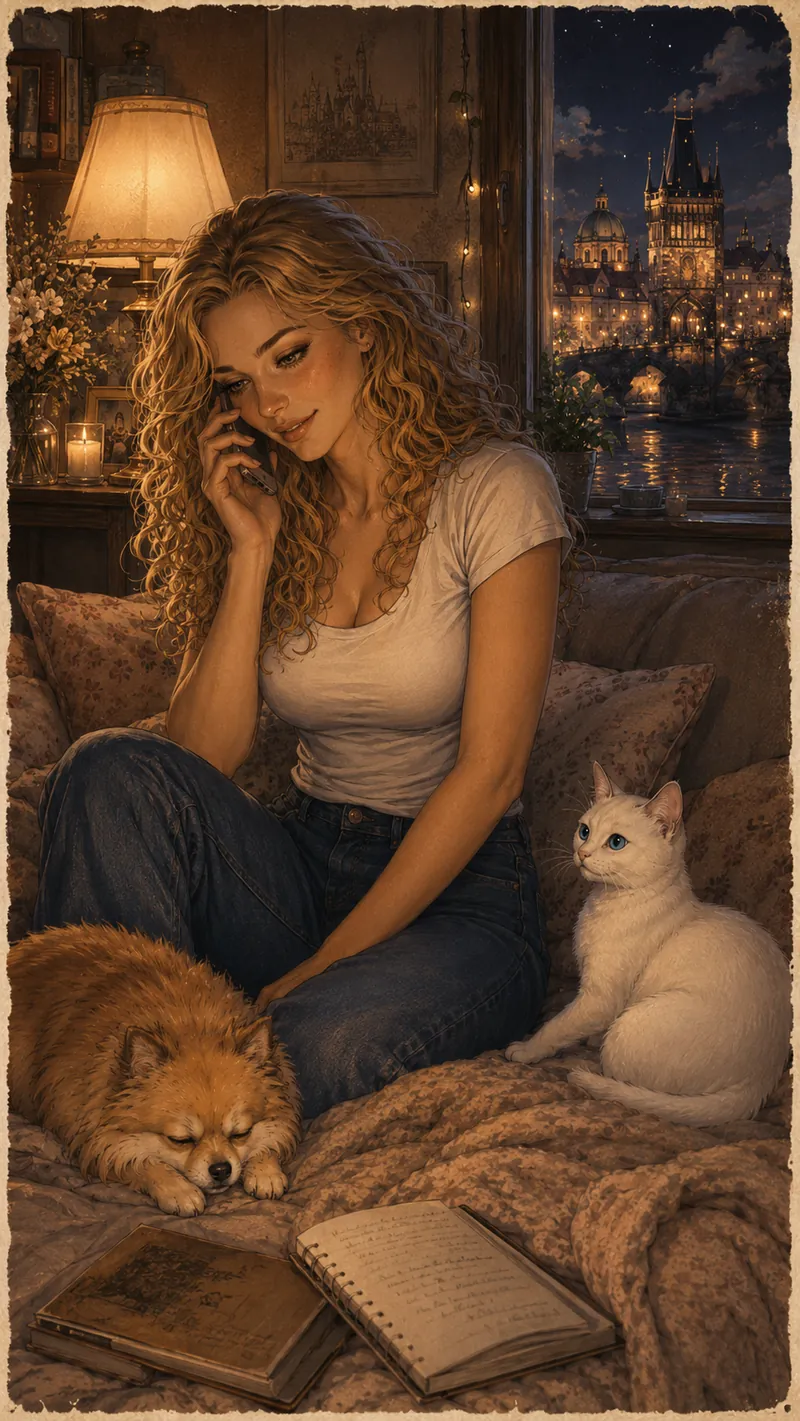
She looked at tickets to Vienna. Then closed the tab. Then opened it again, because anxiety is a bad travel agent — but a persistent one.
When Josh finally surfaced in his stories, Tonya first felt relief, and then such anger that even the cat jumped off the sofa in advance, like an experienced evacuator of emotions. He was alive. He was posting strange videos. Laughing. Pretending everything was fine.
He told her he'd only had a coffee, and they hadn't let him on the plane. Tonya looked at the message, then at the kitchen, then at the white cat.
'Coffee,' she said. 'Of course. The most dangerous drug in Europe. The latte of crime.'
The truth was different: he was too drunk. But it was easier for Josh to blame the airport, the rules, the people, the security, the weather, the planet — anything but his own choice.
This was one of his most dangerous mechanisms: he could genuinely feel wronged by the consequences. Not by his actions — by the consequences. As if the world should have understood he meant no harm, and therefore everyone was obliged to make room.
Then it turned out his mother had come to collect him. Tonya stared into space for a long time after that detail. A grown man who spoke to her of children, of coming to Prague, of feelings, of 'I want one with you', still needed his mother to pull him out of the ruins of another collapse.
She didn't laugh. It wasn't funny. It was frightening — the sober realisation of the scale of it: he talked about children, while he couldn't yet keep himself together.
But he showed the ticket again. Promised again. Said again he'd be in Prague in a few days. And Tonya believed again.
Not because she was stupid. Because the dream still stood at her shoulder, like a witness who said, each time: wait — this isn't a coincidence.
A real fear and a fake reason can sit in the same conversation. She is already ready to rescue — even though she doesn't want to. He is already hiding behind an explanation. Both are true. Only one of them is hers to put down.
He could feel wronged by the consequences — never by his own actions. That's not a quirk of character; it's a mechanism. As long as the airport, the rules and the weather are to blame, nothing about him ever has to change.
His mother literally came to collect him from the wreckage. If someone keeps being cleaned up after a grown man, the role you're being offered isn't 'partner.' It's one more rescuer — and that role has no end.
- The explanation matches the facts — it doesn't just protect his pride.
- He owns the choice, instead of blaming the airport / weather / people.
- I separate my real fear from his unreal reason.
Am I holding on to him — or to the dream standing at my shoulder, whispering 'this isn't a coincidence'?
He Did Come. And Still Didn't Show Up.
The main emotional contrast of the whole book: he takes a real step — he flies in — and then fails the quality of being there. An Irish bar instead of a first date. A latte shared with a drunk man. A kiss in a park that was beautiful and wrong.
When Josh actually landed in Prague, Tonya didn't become happy right away. First, her body didn't believe it. It remembered too well the previous promises, the airport, Vienna, the disappearances, the 'just a coffee', and all the small forms of absurd a man can bring a woman instead of a bouquet. She had kids, errands, a deaf cat, a whole real life — and still she wanted something impossibly simple: a small piece of time where she'd be not a mother, not a survivor, not a strong woman with a past. Just a woman who is finally chosen.
He came. After all the words — a real step at last: a plane, a suitcase, her city. For one moment the dream and the daylight lined up in the same place.
She was ready to meet him at the airport. For Tonya, who normally let no one close, that was almost an extreme sport — ready to travel toward a man who hadn't even proven he could arrive on time. He postponed the meeting.
Then again. When she was already in the centre of Prague — among the beautiful streets, the tourists, the old stone, the evening light — he started a strange conflict. Later, not now, in a few hours. Tonya stood in the city that could have been their first real date and read his messages with the feeling that reality had once again swapped the man from her dream for someone else.
An Irish bar. Because of the match. Football — instead of a first date. It wounded her almost the way a real first date can wound: the place where you find out, in one evening, exactly where you rank against a screen.
'No,' she wrote. 'I don't want to meet anymore.'
He deleted her from his friends. It was so childish that the pain didn't even find its shape at first.
Later she went anyway to where he was drinking. Not to make a scene. Not to beg. To look him in the eyes and understand who exactly was destroying this story: an angry man, a sick man, an infantile man, or just a man used to someone else carrying his chaos.
She bought herself a latte. He asked to try it. Tonya was squeamish; she didn't normally share drinks. But he looked like he needed the coffee more than she did — not as a pleasure, but as a small attempt to come back into his own body. She gave him the cup. The staff watched. The waitresses exchanged looks. Josh was loud, drunk, charming in that dangerous way where a man thinks he's decorating the room while everyone counts the minutes to his exit. Tonya felt shame for him. Then shame for herself, for standing beside him.
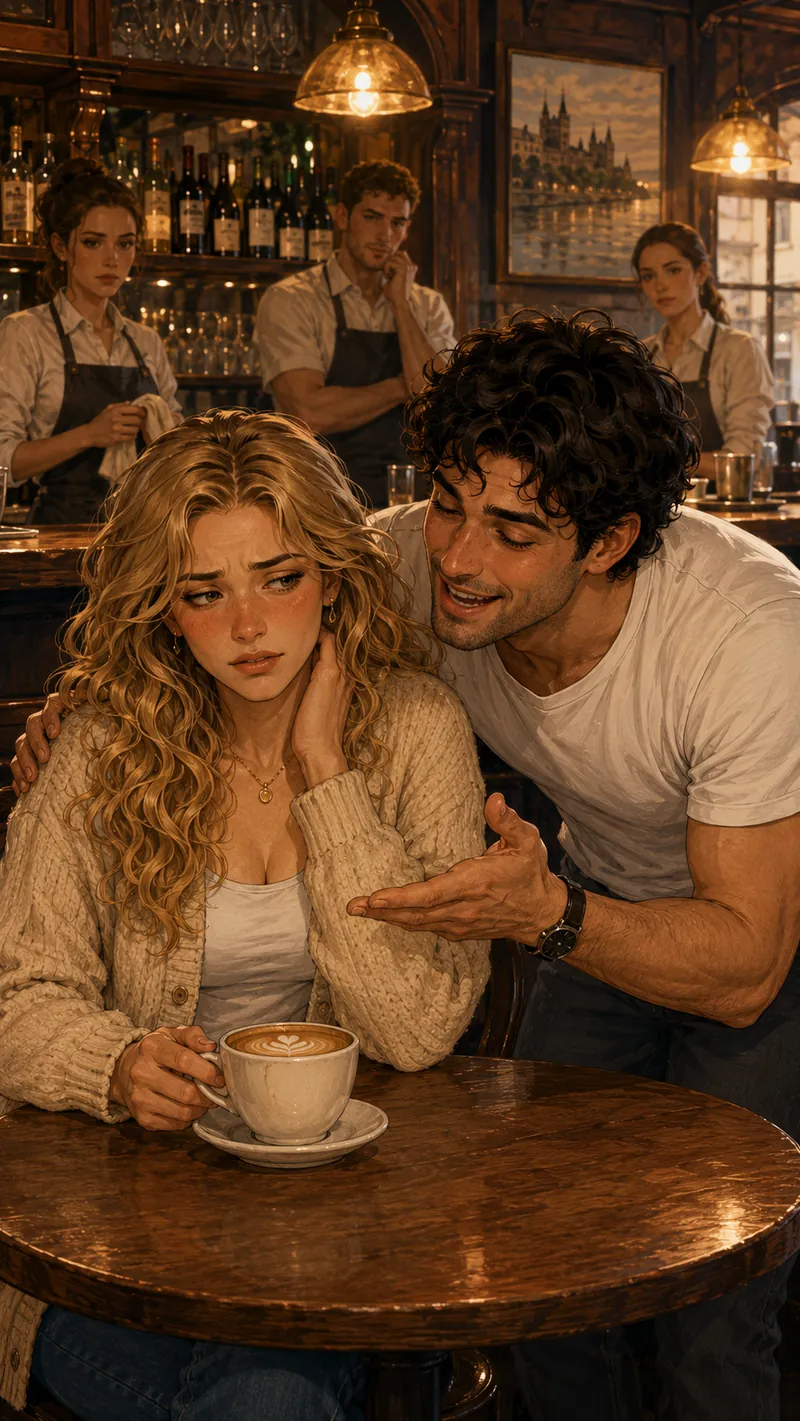
Later they went out into a park. Josh saw someone else's dogs and bolted toward them like a child no one had told that strangers' animals are not a ride. Tonya stood and watched her libido, her list of requirements and her faith in an adult man hold an emergency meeting.
Then he kissed her. She should have pulled away. By every rule, by her whole history, by all her hatred of drunk chaos. But the kiss turned out to be exactly what her heart had been waiting for so desperately that, for a second, her mind lost its right to vote. And in that second Tonya understood two things at once. She was lost. And she'd got lost in the wrong place.
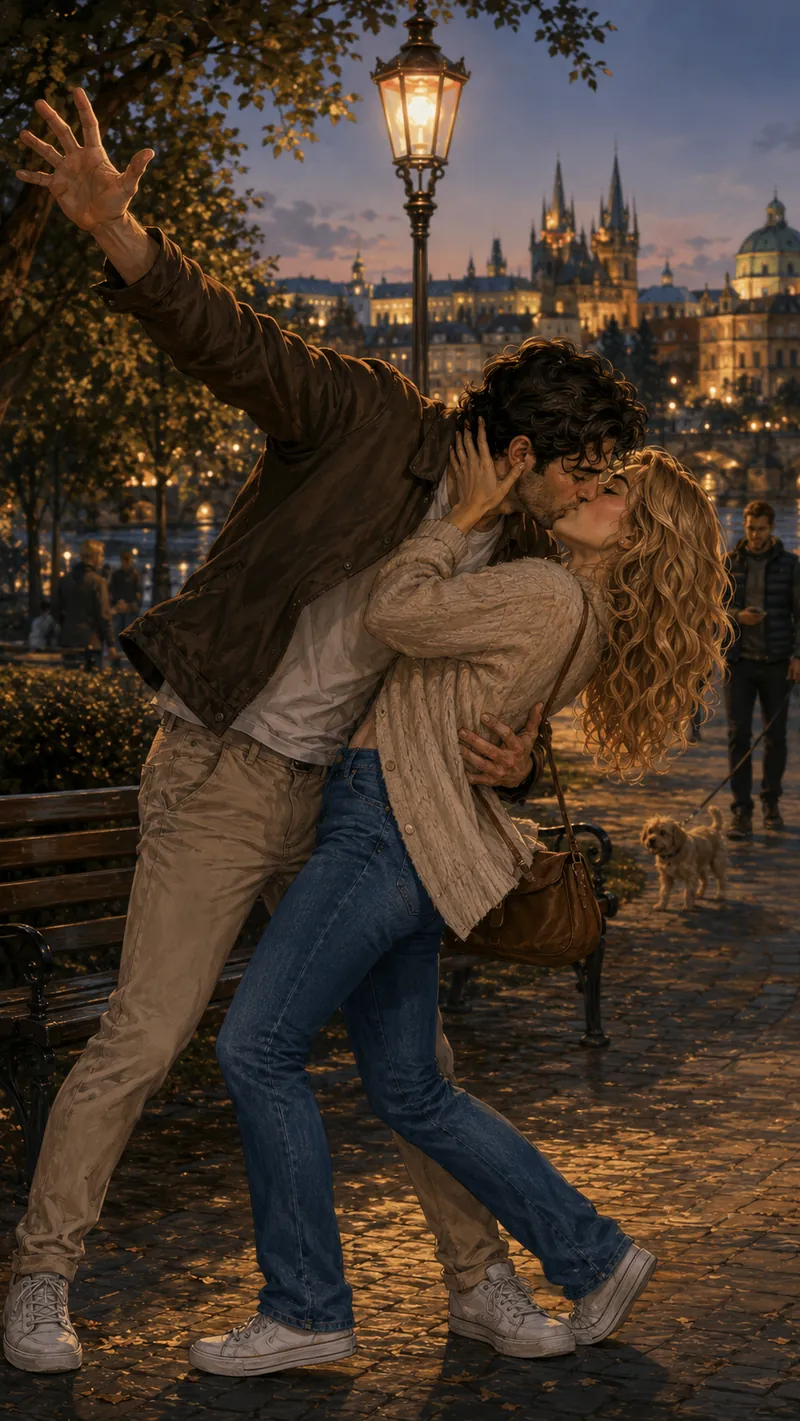
She was lost. And she'd got lost in the wrong place.
He took a real step — he came. And still failed the quality of presence. Arriving is not the same as showing up. Presence isn't a location on a map — it's attention, sobriety and respect, in the room, with you.
- He's here with his attention, not just his coordinates.
- On our 'date', it's me — not football, the bar, the crowd.
- I'm not ashamed of him in front of strangers.
The kiss was what my heart was waiting for — but was it the man my mind would have chosen?
The Week the Desire Died
The honest chapter about how infantility kills not only trust but desire — even when the chemistry is real. A week in Prague that was not a romantic montage.
The next days in Prague did not become a romantic montage. If someone had filmed that week honestly, they'd have had to cut the music and leave the long pauses, the awkward noise, the looks from strangers, the smell of alcohol, her tired face. He was near. That was the problem. Near means you can no longer keep a fantasy alive from a distance. A man in your phone can be a mystery, fate, a wounded boy, a future father, God's answer, a captain — anything. A man right next to you either holds his shape, or he doesn't.
She found herself looking for him — through places, through chats, through familiar faces. The role had shifted without anyone announcing it: she had become a rescuer of a grown man's evenings.
He was loud in public places, and she felt the old, specific shame — the kind that makes a grown woman's body almost physically shrink for a man standing beside her.
He could be loud, he could be funny, he could be tender, he could look at her in a way that melted everything inside. And then he would do something so infantile that Tonya seemed to see in front of her not a man, but a three-year-old boy in a dirty shirt, waving his arms and waiting for everyone to be charmed.
The truly frightening thing was not one specific act, not the lack of manners. It was a metaphor she couldn't unsee: a grown man, and behind him the shadow of a small boy nobody had finished raising.
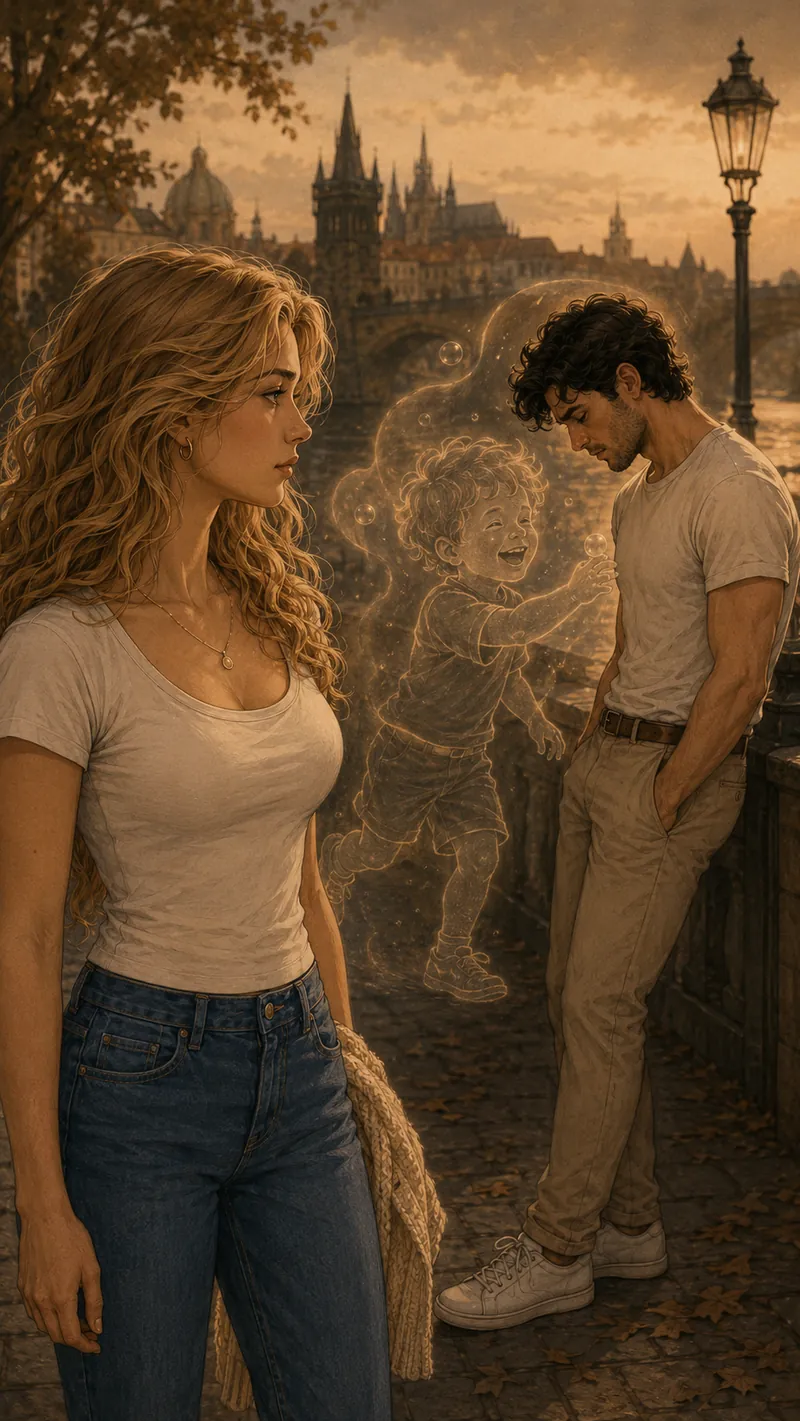
And then desire died. Not dramatically — it just quietly went out. Desire doesn't survive when a partner stops being an adult. Desire doesn't love the role of mother. It refuses to live where you feel ashamed, anxious, and want to hug and shake a person at the same time.
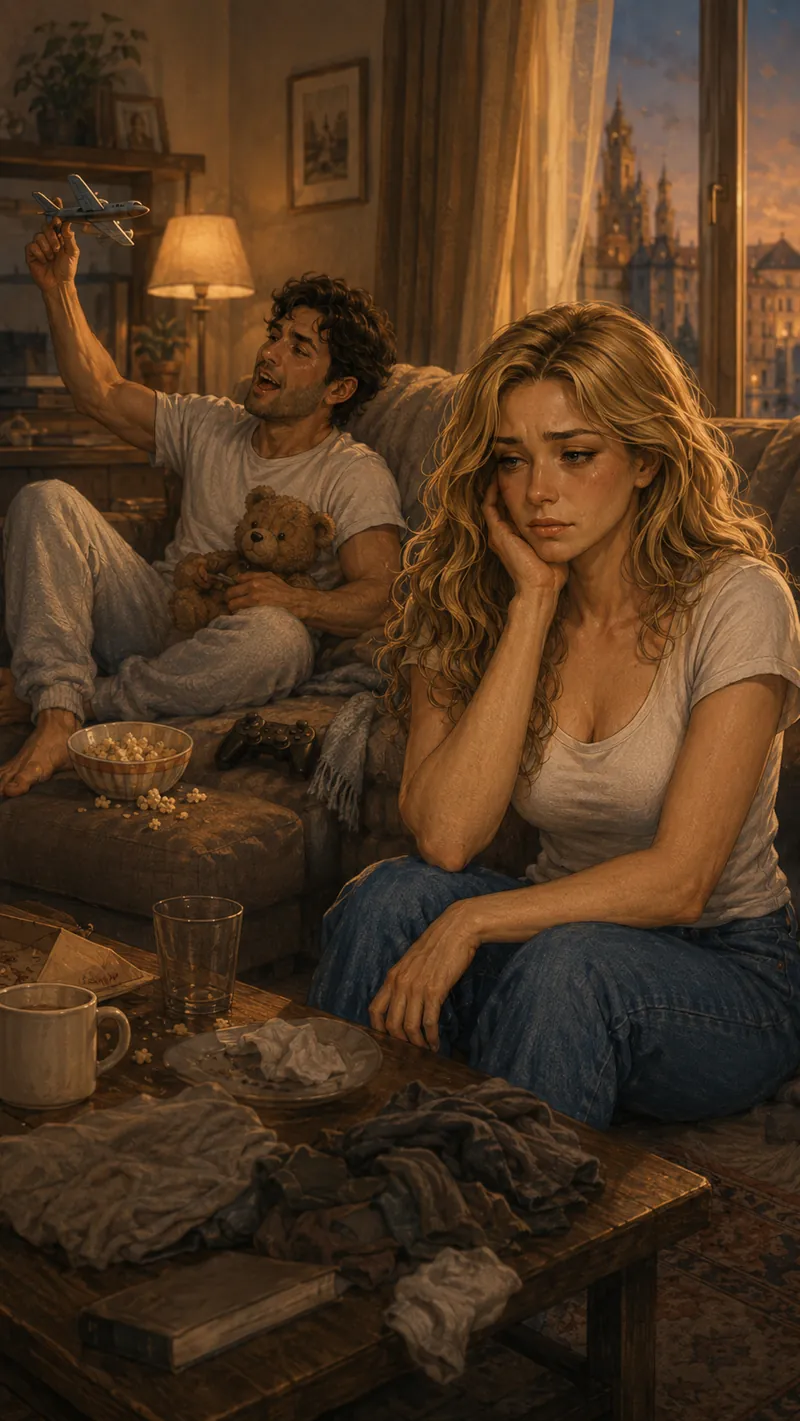
And then, for a second, he was tender — and that confused everything again. The same beautiful eyes, the same warmth. The swing between the boy and the man she'd believed in is exactly what keeps a woman holding on past the moment she should have let go.
He liked being near her — there was no doubt of that. He liked her smell, her softness, her seriousness, her care, her funny mix of romance and sarcasm. Near her, he felt better. But here is what the book has to say without pity and without anger: if a man feels better near you, that does not yet mean he knows how to be better near you.
One night she came home and washed her hands for a long time, though there was nothing visible on them. Tired of the shame, washing off a week that no soap could reach.
On the sink lay the little bracelet she had bought him and never managed to give beautifully. Tonya looked at it and thought, for the first time: maybe I bought a present not for a man, but for my own hope.
The most frightening part wasn't a single act. It was that she never once saw him truly sober — not 'after coffee', but present. Relationships are built sober. Drunk closeness can feel like truth, but by morning it has no passport.
Infantility kills not only trust but desire. Desire doesn't love the role of mother. If a man leaves you ashamed, anxious, and torn between hugging him and shaking him — that's not passion. That's childcare.
- I've seen him truly sober and present — not just 'after coffee'.
- I'm not ashamed of him in front of other people.
- I desire a partner — I'm not parenting a child.
Did I buy a gift for a man — or for my hope of the man he could be?
He Chose Himself While She Chose Him
A chapter of recognition — not a verdict, but clarity. She sees the pattern without turning him into a monster. And she stops arguing with one simple fact.
Tonya sat down at the table and opened her old list. A man should be attentive. Should be curious about her inner world. Should write not only when he's bored, drunk or lonely. Should be able to set a date and actually come to it. Should not humiliate her with public chaos. Should respect her boundaries. Should be able to talk about feelings sober. Should see her children as part of her life, not a line you can scroll past.
A pattern doesn't arrive with a label. It arrives as 'it just happened this once.' Then as 'he was tired.' Then as 'he has ADHD.' Then as 'alcohol is a problem, but he's a good person.' Then as 'he really did mean it.' Then as 'but he came, didn't he.' Then as 'not everything at once.' And at some point a woman discovers she has written a whole dissertation on the reasons she feels bad, instead of admitting one simple fact: she feels bad.
Josh didn't fail at everything. That was the trap. If he'd failed at everything, it would have been easier. But he failed enough for the pain to accumulate, and gave enough warmth for the hope never to fully leave. He wasn't a cold wall — he was a door that kept opening, and then slamming on your fingers.
Josh, meanwhile, lived his own way: movement, people, football, alcohol, stories, jokes. He could think about her. Could miss her. Could be afraid he wasn't enough. Could, perhaps, love as much as he was able.
But love that exists only inside a person and never becomes a repeated action feels, to the other person, like loneliness. She was alone — and yet behaving as if she were in a relationship.
She remembered the dream. The ship. The staircase. The swapped man. The real one hidden inside the wrong one. What if the dream wasn't a sign to go forward? What if it was a warning: you will see the real man inside the wrong one for so long that you'll start mistaking an inner light for an actual act?
Inside, Josh carried his own fear: that he couldn't measure up to her. It was human, it was even sympathetic. But a man's private fear, left unspoken and unworked, becomes the other person's daily reality. His inner struggle did not lighten her load — it became it.
And she understood it, finally, without hysteria: potential is not action. The good eyes, the kind side, the fears, the trauma, the diagnosis, the difficult past and the beautiful words are not the same as showing up. A relationship is tested by repetition, not by promise.
Tonya closed the list. She didn't decide to leave for good — that rarely happens so cleanly in life: the heart doesn't resign on command. But for the first time she stopped arguing with the fact that Josh chose himself in the very moments she chose him.
Two silhouettes, apart: he in the noise, she in the quiet. The same hours, two different worlds. The split wasn't a fight. It was a choice each of them kept making — in opposite directions.
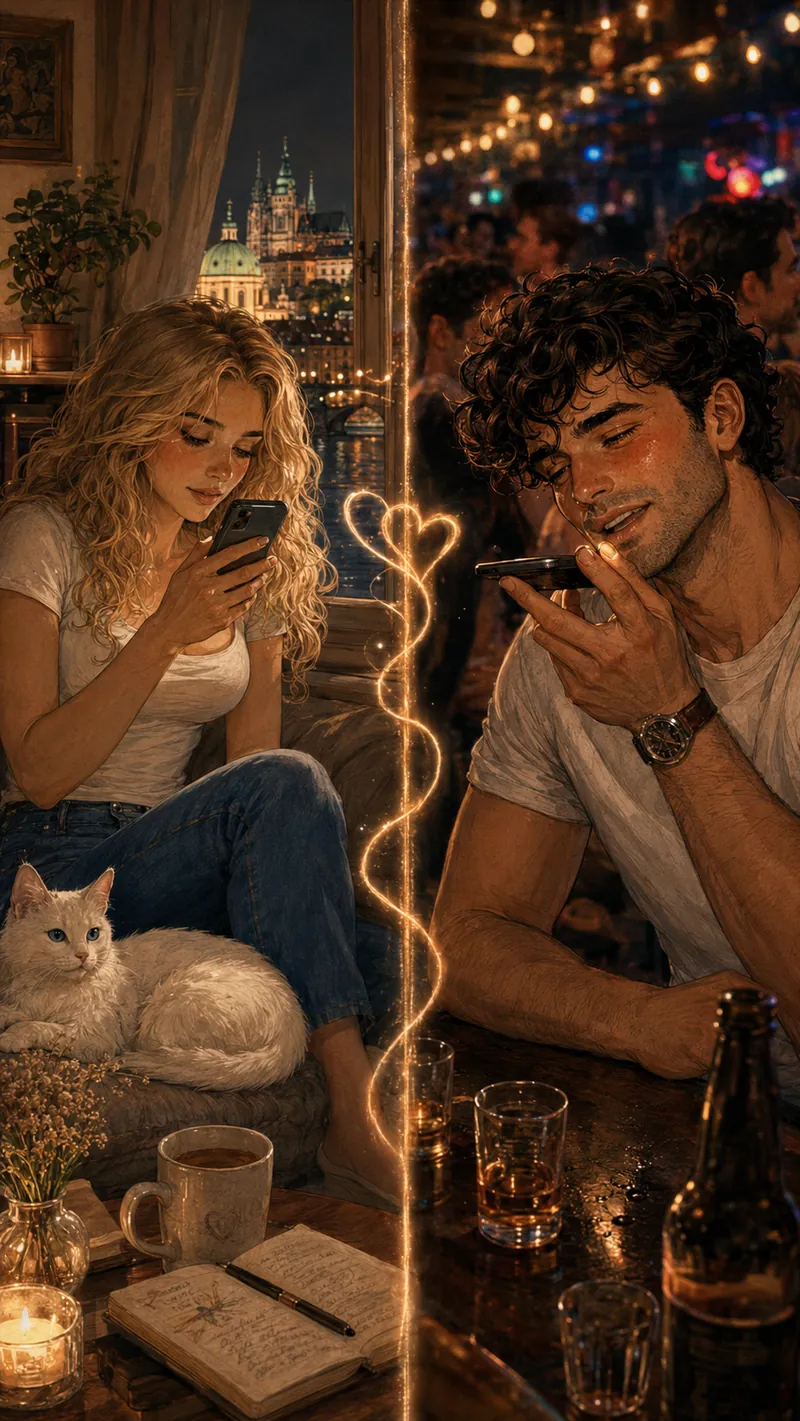
A pattern doesn't come with a label. It comes as one reasonable excuse after another, until you've written a dissertation on why you feel bad instead of admitting that you do. Seeing it isn't cruelty. It's the end of arguing with yourself.
Love that lives only inside a person and never becomes a repeated action feels, to the other one, like loneliness. He chose himself in the very moments she chose him — and no explanation changes how that lands.
- He writes not only when he's bored, drunk or lonely.
- He can set a date and actually come to it.
- His actions repeat — not just his potential.
Do I love him — or the real man I keep seeing inside the wrong one, until I've confused an inner light with an actual act?
Is This the End?
The ending is open. Not 'she forgot him', not 'he changed'. Just a new pause — the moment she stops rushing to rescue, and a millimetre more room opens inside her for herself.
An ending rarely looks like a curtain falling. More often it looks like an ordinary morning, where you have to feed the dog, answer your child, take out the rubbish, pay for something unpleasant, and not be the first to open the chat. No one plays a violin. No one says a beautiful final line. A woman just makes tea and notices that, inside her, there is one millimetre more room for herself.
She looked at Prague and thought how strangely life mixes the sacred and the idiotic. The dream of a captain. The question about 'Anastasia'. A prayer in a church. Demons. Croatia. The police. The latte she handed a drunk man so he might come back, just a little, into a human state. A kiss in a park. Someone else's dogs. An ungiven bracelet.
If this was fate, then fate had a questionable sense of humour. If it was a lesson, it was written in ink that cost far too much. She held the bracelet she never gave — the small, ridiculous proof of a hope she had carried longer than she'd meant to.
She couldn't decide for Josh. She couldn't make him sober. She couldn't set an alarm clock for his adulthood. She couldn't cancel his ADHD, his alcohol, his fears, his avoidance, his mother, his airports, his pubs, and his habit of turning consequences into a grievance against the world.
She could only decide how much longer she would stand in this story as a woman who chooses a man while he chooses relief. Her children, her animals, her real life pulled her back — not as a punishment, but as ground. Solid, unglamorous, hers.
She looked at her list of what a relationship should be, and this time she didn't argue with it. She didn't shrink it to fit him. She didn't call it 'too strict'. She let it simply be true — which is its own quiet form of self-respect.
The dream of the captain now looked less like proof and more like a question. Maybe it never promised her this man. Maybe it only asked her how long she would mistake a premonition for permission. The same ship — a different meaning.
Prague in the morning. She stood at the window — the same window where she had waited, hoped, ached. The city was lightening. So, slowly, was she. A quiet choice, made without an audience.
The phone lay on the table. The cat slept beside it, the dog breathed softly, the city beyond the window grew bright. The screen lit up. Tonya saw his name.
And for the first time, she didn't reach for it right away.

The screen lit up. She saw his name. And for the first time, she didn't reach for it.
An ending rarely looks like a curtain. It looks like an ordinary morning where you don't open the chat first — and a millimetre more room opens inside you for yourself.
She didn't hate Josh — hatred is convenient, it closes doors. She kept tenderness, anger, desire, gratitude for the laughter and resentment for the humiliation, all at once. You can leave without falling out of love. The heart doesn't resign on command.
If he stayed exactly as he is and never changed — would that be a life you could choose, or a hope you'd keep paying for?
The Usefulness Inside the Story
These pages don't replace therapy, a doctor, an addiction specialist, a psychiatrist or crisis help. They're here as safe reflection notes — so a reader can name a pattern, without turning a work of fiction into a diagnosis.
A strong coincidence can grip you not because it proves fate, but because the mind looks for meaning where the heart already wants to believe. The useful question: what did the person DO after the sign?
ADHD can affect impulsivity, attention, organisation and emotional regulation. But an adult is still responsible for how their behaviour affects another. What's needed: a system, support, specialists, honesty and repeated actions.
Drunk tenderness can feel like truth, but relationships are built sober. If alcohol regularly breaks plans, sleep, safety, boundaries and respect — that's not 'cute chaos', it's a risk.
If you explain his behaviour better than he does, search for him, rescue him, justify him and forget yourself more and more — that's not closeness anymore. It's the management of someone else's growing up.
Good eyes, a kind side, fears, trauma, a diagnosis, a hard past and beautiful words are not actions. A relationship is proven by repetition: he came, he wrote, he explained, he repaired, he held.
The Full Book
Potential Is Not a Promise — the full Josh & Tonya book: every chapter, every illustration, the practical reflection pages and bonus material, gathered in one beautiful edition.
The full edition is being prepared. Soon you'll be able to buy and download it here. Want to be the first to know? Join the Emotional Truth Diaries letter.