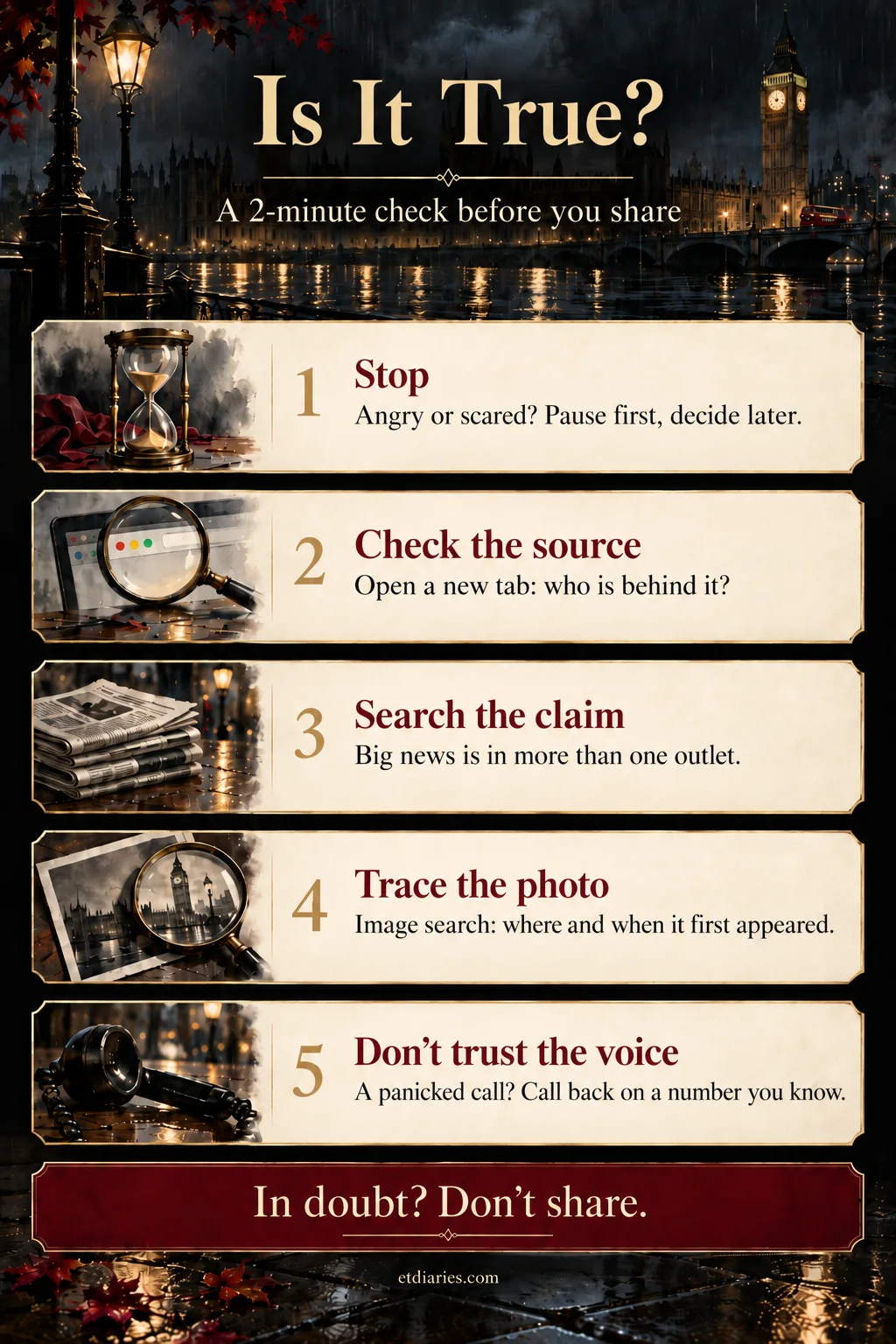
Is It True?
How to Check a Story or a Photo in Two Minutes
23:40. The group chat lights up. A photo of a flooded street, a headline in capitals, «share before they delete it». Three people have already forwarded it.
Chris doesn't. Not because he is cleverer than his friends. Because he has a habit: two minutes before he shares anything.
Here is that habit, step by step.
Why lies travel faster
In 2018, researchers at MIT followed about 126,000 stories shared on Twitter. False stories were 70% more likely to be retweeted than true ones, and the truth took about six times longer to reach 1,500 people.
It wasn't mainly bots. It was people. False stories tend to be more surprising and stir stronger feelings, and those are exactly the stories we pass on.
Step 1. Stop when you feel the urge
If a post makes you furious, frightened or a little smug, that is the moment to slow down. A strong feeling is not proof. It is a sign that someone may want you to act before you think.
The digital literacy researcher Mike Caulfield built a whole method around this first move. He called it SIFT: Stop, Investigate the source, Find better coverage, Trace it back to the original.
Step 2. Check the source in a new tab
Don't study the post itself: logos, official-looking names and confident wording are easy to fake. Open a new tab and look up who is behind it.
In a Stanford study, professional fact-checkers did exactly this. They left a website after a quick look and checked what others said about it. They reached better conclusions, in a fraction of the time, than historians with PhDs and university students who kept reading the page itself.
Step 3. Search the claim, not the link
Type the claim itself into a search engine. If something big really happened, several independent news outlets will have it. If only one account is shouting about it, wait.
Google Fact Check Explorer searches the work of many fact-checking organisations at once, in different languages.
Step 4. Trace the photo
Old photos come back all the time: a flood from years ago becomes «today». Search the image with Google Lens or TinEye and look for the earliest copy, with its date and place.
Screenshots of «posts» are the easiest thing to fake. Look for the original post on the account itself. If you can't find it, treat the screenshot as unconfirmed.
And what about AI?
Extra fingers and melted letters used to give fake images away. Newer generators make far fewer of those mistakes, so a clean-looking picture proves nothing.
Some AI tools and cameras now attach Content Credentials, a kind of digital label you can check at contentcredentials.org/verify. If the label is there, it shows how the file was made. If it is missing, that proves nothing either way: labels are easy to strip.
Chatbots are not fact-checkers. They can sound sure and still be wrong, and they sometimes invent sources. If an AI gives you an answer, ask where it comes from and open the source yourself.
When the panicked voice is family
Scammers can copy a voice from a short clip posted online and call pretending to be someone you love, in trouble and needing money. The US Federal Trade Commission's advice is simple: don't trust the voice. Hang up and call your person back on a number you know is theirs, or reach them through someone else.
23:40. A photo of the flood. «Share before they delete it».
23:41. New tab. Image search.
23:42. The same photo, years old, another country.
23:43. Group chat: «Guys, this one's old». Typing… Typing… Silence.
Chris, London Diary
In short
A post makes you angry or scared: stop first.
Don't judge by the page: open a new tab and check who is behind it.
Search the claim, not the link. Big news is never in one place only.
Old photos come back as new: search the image and find the earliest copy.
A missing AI label proves nothing. A chatbot's answer needs a source you can open.
A panicked call from family: hang up and call back on their own number.
Sources: Vosoughi, Roy & Aral, «The spread of true and false news online», Science, 2018; Mike Caulfield, «SIFT (The Four Moves)», 2019; Wineburg & McGrew, lateral reading study, Stanford, 2019; US Federal Trade Commission, consumer alert, 2023. Tools: Google Fact Check Explorer, TinEye, Content Credentials Verify.